
Blog
Wikis Were Great in 2008. It's Time for the Next Era
Fandom is broken, MediaWiki is outdated, and Wiki.gg is incremental. Explore the best wiki and Fandom alternatives in 2026 — community-owned, ad-free, and AI-augmented.
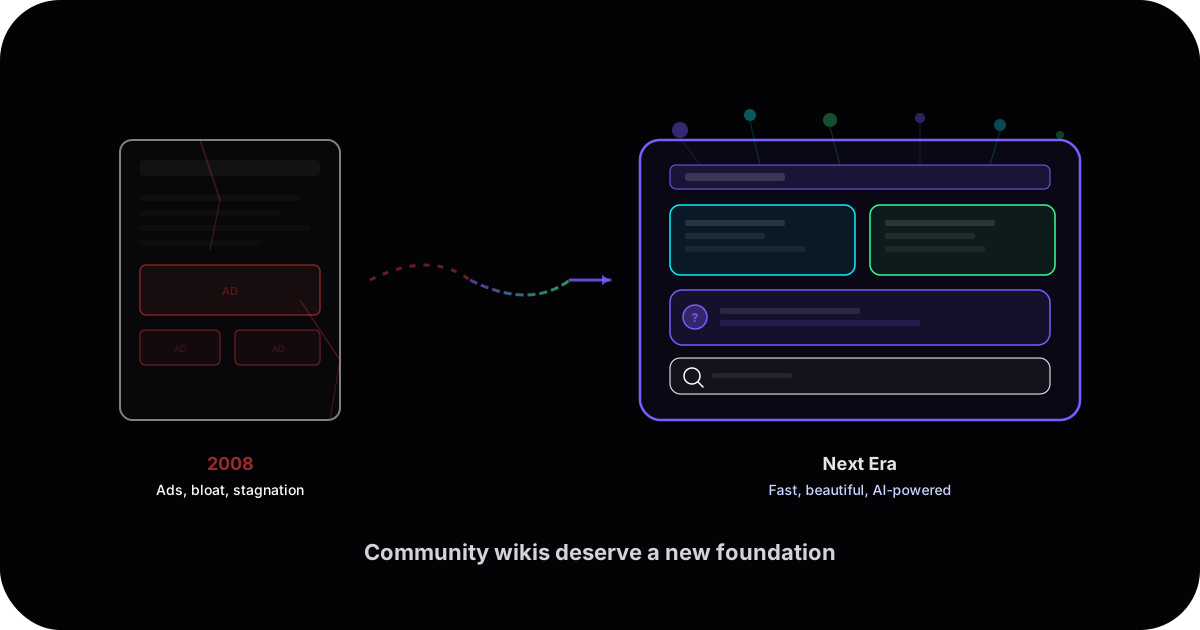
Why Fandom, Wiki.gg, and MediaWiki Are Failing Communities — and What Comes Next
TL;DR
If you're short on time, here's the summary:
- Fandom is broken. It's bloated with ads, slow to load, and hijacks community work for profit. Many readers can't even access content without an adblocker.
- MediaWiki is powerful but outdated. It's hard to self-host, harder to customize, and hasn't evolved much in 15+ years.
- Wiki.gg is better, but still incremental. It fixes speed and ads, but the core experience is still a traditional static wiki.
- User behavior has changed. People expect instant answers, natural language search, and mobile-friendly design. Traditional wikis don't deliver.
- Kiori is what's next. A new platform built from scratch for community-owned, ad-free, AI-augmented, beautifully designed wikis. You keep control. Your users get answers.
We've been building this. It's called Kiori.
The rise (and stall) of community wikis
In the mid-2000s, community-driven wikis flourished. Platforms like Wikia (now Fandom) gave fans and hobbyists a place to build collective knowledge on everything from video games to TV lore. By 2008, wikis felt revolutionary — anyone could contribute, communities proudly curated their "collective memory," and content was always just a search away. Fast forward 15+ years, and that familiar wiki interface hasn't fundamentally changed. Sure, the nostalgia is there: the clustered text articles, the infoboxes, the blue hyperlinks. But beneath the familiarity, the wiki experience has largely stagnated. Modern wiki platforms are creaking under old designs and bad decisions, and communities are increasingly frustrated with the status quo. The once-great promise of community wikis has soured, as the chorus of complaints now echoing across Reddit threads and blog posts makes clear. At its core, wikis suffer from the same problem all knowledge systems face: answers become disposable instead of living knowledge.
What happened? In short: corporate ownership and neglect. Fandom (formerly Wikia) became the dominant wiki farm by absorbing others (e.g. Gamepedia), only to smother users in advertisements and bloat. Self-hosting a wiki using MediaWiki (the same software that powers Wikipedia) is an option for autonomy — but it's notoriously complex to maintain and hasn't kept up with modern UX expectations. Newer alternatives like wiki.gg have sprung up to offer cleaner, faster wiki hosting (especially for gaming communities), but even these are incremental fixes rather than a true leap forward. The result is that in 2024, many community wikis feel stuck in 2008. The interface and workflow are virtually unchanged, yet the internet — and user expectations — have moved on dramatically (think social media feeds, mobile-first design, and now AI-driven experiences). It's time to critically examine these platforms and ask: what needs to change for wikis to thrive in the next era?
Fandom, Wiki.gg, MediaWiki: the state of play (and frustration)
To understand where wikis need to go, the problems of today need to be acknowledged. Here's a look at the big players in community wikis and why users are increasingly fed up:
Fandom (Wikia)
Once a friendly free wiki host, Fandom has become "one of the most dreadful parts of the internet," as one veteran editor put it. [1] The complaints are loud and clear across countless discussions.
Excessive advertising is the number one grievance: "It is impossible to ignore Fandom's greatest issue: The ads," writes one user, noting that without an adblocker a page took 1.5–2 minutes to load on Fandom versus 2 seconds on a cleaner alternative (Wiki.gg). [1][2] Fandom pages are plastered with so many banners, pop-ups, autoplay videos and even scammy "green link" ads that readers feel the site has "more ads than the average porn or piracy website." [3] On mobile, it's practically unusable — users report having to close multiple ads just to read a paragraph, with the page jumping around every few seconds as new ads load. One frustrated redditor described it as a "glorified ad delivery platform" rather than a wiki. [4]
The UX nightmare goes beyond just quantity of ads: garish site-wide sidebars and "Fan Central" flyouts distract and annoy core readers. Autoplay videos are injected into pages even when irrelevant, seemingly just to boost user dwell-time metrics and video ad inventory. [5] In one vivid account, a user trying to read a Fandom wiki without an adblocker said "for about five seconds I thought I'd somehow installed All The Viruses" on their computer. Pop-ups and redirects were so aggressive they likened the experience to visiting a malware site. [6] It would be almost funny if it weren't the everyday reality for readers.
Community backlash: The result of these choices? An exodus of contributors and readers. Active fan communities have migrated en masse off Fandom to escape the shoddy experience. "Nearly every big game has a wiki better than Fandom," one commenter observed, pointing to non-Fandom wikis for Minecraft, Terraria, Pokémon, WoW, and more. [7] These independent wikis or those hosted on alternatives like Wiki.gg often started as straight forks of the Fandom content, but free of the sludge of ads and trackers. Users are so fed up that volunteer projects have appeared to route around Fandom entirely — e.g. BreezeWiki, a proxy that strips out Fandom's ads and videos to make pages readable. [8] On social media and forums, fans encourage each other to avoid giving Fandom the traffic: "I have blocked the [Fandom] domain on my browser... communities have moved on to other wikis." [9]
Perhaps most telling, many note that Fandom's design teaches a new generation why adblockers are essential. There is also deep resentment in the contributor community about ownership and exploitation — Fandom is owned by private equity, and editors increasingly ask why they should "work for free to enrich some private equity firm" by adding content to a site that merely monetizes their labor with intrusive ads. [1] That sense of "being exploited" is real and poisonous. One long-time wiki admin described how their pride in building a wiki turned into a feeling of being exploited by a company with misaligned goals. [1] Fandom's business incentives (maximize ad revenue) directly conflict with the community's mission (maximize quality and usability of knowledge), and users feel it.
SEO and ownership concerns: To make matters worse, even when communities do leave Fandom, they face an uphill battle due to Fandom's grip on search engine rankings. Fandom will often keep the old wiki online (frozen or with minimal updates) even after the community moves, and Google continues ranking that ad-laden ghost site above the new wiki because of the years of SEO momentum. Since roughly "85% of a wiki's traffic comes from Google," this is a huge barrier. [1] The departing community essentially competes with its own outdated content, and many casual users keep ending up on the Fandom site without realizing there's a better version elsewhere. This practice has a chilling effect — historically, many attempted breakaway wikis fizzled out as traffic stayed on Fandom, allowing Fandom to "further prioritize revenue extraction" without consequence. [1] The fact that Fandom doesn't easily let communities redirect or announce their move speaks volumes about ownership: at the end of the day, Fandom controls the domain, the SEO, and thus the audience. The community may have created the content, but they don't truly own the platform or visibility. This lack of autonomy (the feeling of being trapped) is a common gripe now. "If leaving Fandom was easy, they wouldn't be able to enshittify as much as they have," the Runescape Wiki team bluntly noted. [1] In other words, the platform's ability to mistreat users is directly related to how hard it is for communities to reclaim their content and audience elsewhere.
Wiki.gg
In response to Fandom's decline, Wiki.gg emerged as a refuge for many gaming communities. Founded by folks who were frustrated with Fandom (some even ex-Fandom staff), Wiki.gg hosts wikis with a promise of fewer ads, faster load times, and greater responsiveness to community needs. By most accounts, it delivers a cleaner experience — one user testing wiki.gg vs. Fandom found the difference "MASSIVE," with wiki.gg pages loading near-instantly and only a few unobtrusive ads for relevant games, compared to Fandom's minutes-long load and visual onslaught of random ads (gambling sites, scammy downloads, etc.). [2]
Wiki.gg still relies on advertising to fund hosting, but they explicitly limit it to "subtle, far less numerous" ads, often directly related to the wiki content (e.g. ads for the game itself). [2] Crucially, wiki.gg doesn't plaster over the content or tank performance. Many major game wikis (for example Terraria, WoW's Warcraft Wiki, Elden Ring Wiki, among others) have now moved to wiki.gg or independent setups, and their communities sing its praises.
That said, wiki.gg is not a panacea. It's focused mainly on gaming/fandom communities and is itself a centralized host (run by a company) — albeit one with a much more community-friendly stance than Fandom. It addresses some symptoms (ads, speed) but doesn't represent a radical evolution of what a wiki could be; the core is still a standard MediaWiki site with a better skin and management policy. Wiki.gg shows that incremental improvement is possible when the host actually cares — but is it the endgame for community knowledge? Unlikely. It still inherits the limitations of the traditional wiki platform (more on those soon), and being ad-supported means it could one day face pressures too (hopefully not to Fandom levels). At best, it's a stopgap that proves communities want something better.
MediaWiki (self-hosting)
For communities wary of any corporate platform, the alternative is to go fully independent: self-host a wiki on open-source MediaWiki software (the same engine behind Wikipedia). This route grants full ownership of data and control — no unwanted UI changes or ads forced on you. Many of the most beloved game and hobby wikis are indeed independent (often using MediaWiki): examples include Bulbapedia (Pokémon), UESP (Elder Scrolls), the official Old School RuneScape Wiki, and countless others. [1]
Going independent, however, comes with serious trade-offs. MediaWiki is powerful but complex and dated in design. One Hacker News user described how "MediaWiki is complex, takes more time to administer... upgrades broke the installation a few times, and frankly the interface looks outdated... it needs customization which takes time." [3] In short, running your own wiki can be a huge technical maintenance burden — updates, extensions, server costs, spam protection, backups — essentially an IT admin is needed. Many fan communities don't have that capability or desire; they just want to write lore and guides, not debug PHP errors on each upgrade.
MediaWiki's user experience also hasn't evolved much in two decades; it was designed in the early 2000s and still feels like it. As another commenter put it, "It also hasn't changed much in two decades" — which is a double-edged sword (stability, but stagnation). [3] Modern features like real-time collaboration, intuitive WYSIWYG editing, or built-in multimedia embedding are lacking or require clunky extensions. Even simple things like customizing the navigation can require fiddling with template code. All this means self-hosting is often out of reach for small communities, or leads to a wiki that quickly becomes outdated because nobody is tending to the software.
There's also the issue of discovery: an independent wiki on its own domain has to build up its SEO from scratch. Google tends to favor the long-established Fandom URLs, so a new independent wiki might languish in search results unless the community actively promotes it or the old site is taken down. Despite these challenges, the fact that so many communities are going independent (or to wiki.gg) underscores how fed up they are with the alternative. They're willing to battle technical headaches and SEO hurdles just to have a wiki that serves them and their readers, not a corporate overlord.
The common thread
Whether it's anger at Fandom's ads and poor UX, or the difficulty of wrangling MediaWiki alone, it all boils down to a sense that current wiki platforms are failing their communities. The frustration is palpable: "Fandom wikis suck... THE WORST... I will never, EVER touch another Fandom wiki" rants one user after cataloguing a nightmare browsing session. [4] "It's rapidly becoming unusable... [they're] driving their userbase away with all of these ads," warns another. [6] Contributors lament that Fandom's model doesn't even incentivize quality: "Nothing in this business model requires them to provide high quality information... they aren't interested in providing good quality" content, only in being "findable" and ad-laden. [1]
Indeed, some fandom wikis on Fandom have fallen into disrepair — active editors left, and what remains is outdated info or even deliberate misinformation (some game communities have reportedly sabotaged the Fandom versions to drive people away). All of this paints a clear picture: the wiki status quo isn't working. The familiar wiki interface may still be standing, but the foundation is cracking — both in technology and trust.
What are wikis for, anyway?
Amidst all this talk of platforms and pain points, it's worth stepping back to recall why wikis exist in the first place. What role do they serve for communities and users? Understanding this will guide what the "next era" of wikis should prioritize. Historically, community wikis have been about:
Collective memory: Wikis are the long-term memory of a community. They store accumulated knowledge, lore, and data so it's not lost to forum purges or Discord scrollback. A good wiki is an organized knowledge base that the community can point to as the canonical resource on their topic. In a gaming wiki, for example, every item, quest, and patch note might be documented; in a fandom wiki, every character, episode, and bit of lore. This collective archive is crucial for preserving information and insight that would otherwise fragment across hundreds of posts or individual minds.
Onboarding newcomers: Wikis often serve as the on-ramp for newcomers to a community or complex topic. New players or fans can quickly get up to speed by reading the wiki's beginner guides or background pages. Think of a new fan of a long-running TV series — a community wiki can provide a character guide, timeline, or glossary that eases the learning curve. This onboarding role is vital for community growth: it helps convert curious outsiders into informed participants. (It's also why bad wiki UX is so damaging; if a newbie's first experience is a slow, ad-riddled page, they might just give up.)
Look-up reference: Perhaps the most common use-case: quick look-ups. Wikis are encyclopedias; they excel at giving a specific piece of information when it's needed. What's the crafting recipe for X? Which episode did Y happen in? What are the base stats of Z item? Users often come via Google with a very targeted question, and the wiki page is there to provide the answer (hopefully without too much scrolling). This aligns with the original vision of Wikipedia — knowledge on demand. For communities, being the trusted reference is a point of pride. It means the wiki has done its job organizing knowledge in a retrievable way.
Deep dives and browsing: On the flip side of quick lookups, wikis also facilitate browsing and discovery. The famous "wiki rabbit hole" effect applies on community wikis too. A user might start on one page, then click an intriguing link to another, and another — exploring the network of knowledge. This nonlinear discovery of relationships (how concepts interconnect) is something wikis naturally enable via hyperlinks and category pages. It's great for serendipitous learning or entertainment: e.g. browsing lore pages of a fantasy world just for fun, or jumping between interconnected biographies of historical figures on a history wiki. Unlike a linear article or forum thread, a wiki is a web of knowledge that can be navigated in multiple directions.
Community collaboration: The act of building and maintaining the wiki is itself a community activity. Dedicated wiki editors are often passionate fans who find fulfillment in curating information for others. A wiki can be a project that galvanizes a community — "let's document everything!" — fostering collaboration and a shared mission. That dynamic was a huge part of what made early wikis magical: strangers coming together to build something useful and lasting. As one wiki admin reminisced, "I loved contributing to wikis, building something with other people, and feeling a sense of ownership (and pride that so many people were using stuff I made)." [1] This intrinsic motivation is what powers volunteer-driven wikis. Any new era wiki should cherish and empower these community builders, not demoralize them.
In summary, wikis are for knowledge preservation and dissemination, for educating newcomers and assisting veterans alike, and for connecting information in meaningful ways. They are part library, part guidebook, part database, part collaborative project. The core ethos is community-powered knowledge — information by the people, for the people who care about that niche. When the critique is that wikis have stagnated, it's largely because they have failed to enhance these core purposes (and in some cases have undermined them with profit-driven design). A wiki drowning in ads interferes with quick lookups and deters newcomers. A wiki that's hard to edit or locked down stifles community collaboration. A bare-bones text wiki without modern navigation or search makes discovery of relationships harder than it needs to be.
The "next era" of wikis must reinforce what wikis are truly for, in a way that fits modern user behavior and technology. And that brings up a critical point: how have user expectations changed, especially in the age of AI and instant answers?
Modern knowledge-seeking: why wiki users in the 2020s aren't satisfied
If the average user from 2008 time-traveled to today, they'd find the internet both amazing and overwhelming. People in 2026 expect information on demand and often in a condensed, convenient format. Google's instant answers, YouTube explainers, Reddit threads, and yes, AI chatbots, all offer knowledge in a way that feels more direct than combing through a long wiki page. Community wikis risk becoming relics if they don't adapt to how people now ask questions and consume information. Some trends in modern user behavior include:
Search first, not navigation: Fewer users start at a homepage and navigate down a hierarchy of pages. Most begin with a search query (often on Google) and jump straight to the page that appears — yet searching PDFs and documentation still sucks, and wiki search is no better. This means every wiki page must stand on its own, and the ability to answer the specific question is paramount. If the page is bloated with irrelevant sections, or the answer is buried, the user bounces. Even within a wiki, users prefer typing into the search bar over clicking through category trees. Modern users are conditioned to expect quick search results rather than manual browsing of an index.
Snippets and summaries: Thanks to search engines and AI, users increasingly get summaries of information without reading the full source. Google shows snippet excerpts that (ideally) answer the query immediately. AI assistants (like ChatGPT or others) can produce a conversational answer pulling from various sources. While these tools are not always reliable, the convenience factor is huge. It means users often want the gist of a topic or a quick fact, not necessarily a detailed exposition — unless they're in deep-dive mode. Wikis have traditionally been long-form and reference-style, which is great for depth but can be overkill for someone who just wants a quick clarification. There's an opportunity here: what if wikis themselves could provide concise answers or highlights for common questions?
Natural language queries: Hand in hand with the above, people are getting used to asking questions in full sentences (to virtual assistants or AI) rather than using boolean or keyword searches. Instead of navigating a wiki's table of contents, a user might just think, "What happened in [Game X] storyline after character Y disappeared?" and want that answered. Today, they might search Google or Reddit for that, or ask an AI. Ideally, a community wiki contains the answer — but the user might not know how to find it or which page to read. The future wiki experience could allow users to ask their question directly and get an answer drawn from the wiki's verified content. This would make wikis far more accessible to those who don't know how to manually sift for the info.
Mobile and multimodal consumption: A huge portion of users access wikis on mobile devices now. The old web design of fixed sidebars and tiny text is a pain on phones (as seen with Fandom's issues). Users expect a smooth, app-like experience on mobile, with content that's easy to scroll and menus that don't overwhelm the screen. Additionally, content is increasingly multimodal — images, videos, interactive elements. A modern user might prefer a quick infographic or video clip in some cases instead of paragraphs of text. Or they might want to hear an audio summary. Traditional wikis are almost entirely text (with images as static embeds). There's an opportunity for richer content presentation to meet varied preferences and make knowledge more digestible.
Discovering relationships and context: While quick answers are important, enthusiasts also love seeing the broader context and relationships in data. Modern users appreciate features like graph visualizations, timelines, maps, etc., that show how things connect. For example, a genealogy chart of characters, or an interactive map of a game world linking to wiki pages. Right now, wiki editors sometimes create these manually (in text or as an image). But new tech could make relationship discovery more dynamic: e.g., "show me how these two characters are related" and get a generated relationship graph, or "list all items in this game that have the poison effect" and get an instant list (a query that might involve semantic tags). The point is, users often have relationship questions or want to browse by concept, not just read article prose. Wikis have the data but haven't exposed it in user-friendly ways.
In essence, today's users have higher expectations for speed, convenience, and interactivity. Community wikis have the rich content that, say, a random AI answer might lack — but the wiki needs to deliver it in a modern way. Otherwise, casual users will gravitate to whatever gives them the path of least resistance (even if that's a Reddit thread full of speculation or a YouTube video with half-truths). This is a key motivation for evolving the wiki model: to ensure the community's curated knowledge remains the go-to resource, it must be presented and integrated in the formats people now find useful. That means embracing things like Q&A interfaces, summaries, better search, and multimedia, all while maintaining the depth and accuracy that is a wiki's strength.
Why wiki UX stalled (and why the AI era changes the game)
Given those new user behaviors, it's striking that wiki software hasn't evolved much. Why has wiki UX stalled out for so long? Partly it's cultural — "if it ain't broke, don't fix it." Wikipedia's enduring layout cast a long shadow; many assumed the classic article + sidebar + references format was "good enough." Also, wikis are inherently community-driven and often volunteer-run, meaning there's caution around big changes (for fear of breaking content or alienating contributors). But "ain't broke" no longer applies — as discussed above, it is broke for many users (and even communities leaving en masse is a flashing red sign).
Meanwhile, the arrival of the AI era is a paradigm shift that wikis haven't kept up with. What does "AI era" mean here? Tools like large language models (ChatGPT and its kin) that can generate human-like answers from big data. These models don't need a nicely formatted wiki page to answer a question — they can ingest raw text from anywhere. In fact, many have likely trained on wiki content. The problem is, without grounding, AI can hallucinate or give outdated info. The opportunity is to marry the two: the trustworthiness and depth of curated wiki data with the convenience of AI delivery. But current wiki platforms have no concept of this. Fandom's attempt at slapping "AI Q&A" on pages was widely ridiculed as "garbage AI-generated Q&A" that added no value — likely because it wasn't context-aware or well-implemented, just another widget. [1] The bar can be raised significantly by deeply integrating AI in a way that augments the wiki rather than polluting it.
Here are some specific pain points of wiki UX that an infusion of fresh design thinking (and AI assistance) could address:
Information overload and losing the thread
Classic wiki pages can be wall-of-text affairs. For complex topics, a single page might span thousands of words, dozens of subsections, and a forest of links. It's easy for a reader to get overwhelmed or distracted. As we explored in losing the thread of thought, cognitive science tells us that humans can only comfortably hold a few pieces of information in working memory at once (roughly 4 items). [10] When confronted with too much disorganized info, readers lose the thread of what they were originally looking for. This is exactly what happens to many users on dense wiki pages — they scroll, they skim, they forget what they were trying to answer.
As earlier research on cognition noted, modern multitasking and info overload often "push those limits, causing us to lose our train of thought (our 'reasoning thread')." [10] Today's wikis do very little to mitigate this. AI could help by dynamically summarizing sections, highlighting relevant snippets, or even offering a quick "answer box" at the top of a page for commonly sought facts (so the user doesn't have to hunt). By providing contextual assistance, an AI-powered wiki interface could prevent users from drowning in information or straying off-course. Think of it like a guide that can say: "It looks like you want to know X; here's the key point from this page. If you need more detail, read on below." This doesn't replace the content; it just makes it more accessible given cognitive constraints (which, as research shows, are very real even for those who think they can multitask through anything).
Static content vs. dynamic queries
Traditional wikis are static documents optimized for reading, not querying. But a lot of use cases (especially with AI) are essentially queries: e.g., "show me all characters who interacted with both Alice and Bob" or "what's the combined effect of skill X from game Y at level Z?". In old wikis, the answer requires manually cross-referencing pages or hoping someone compiled that info.
A modern approach would treat the wiki's data as a knowledge graph that can be queried. AI can assist in interpreting a natural language question and then retrieving and aggregating the relevant info from multiple pages (this technique is often called RAG — Retrieval-Augmented Generation). For example, if a user asks an AI assistant on the wiki, "What are the known weaknesses of all dragon-type enemies in [Game]?", the system could pull data from all relevant pages (assuming those pages list weaknesses) and compile a brief answer with references back to each source page. This kind of cross-page answer is powerful — it's like having a research assistant comb the wiki. None of the popular wiki platforms currently offer this, but it's exactly the sort of thing the AI era enables and users increasingly expect.
Stale, outdated UI
The visual and interactive design of wikis has barely budged. Vector skins, Monobook skins... they changed a little around the margins, but the experience is still very Web 1.0: lots of text, sparse styling, clunky navigation menus. Meanwhile, modern web apps have shown that customization and beauty matter. Community wikis are expressions of fandom — why shouldn't they be visually appealing and tailored to the community's aesthetic?
In 2008, making a wiki page "pretty" was hard (CSS knowledge, template hacks, etc.). In 2026, the tools exist to allow drag-and-drop page design, rich media embedding, and themes — without sacrificing the collaborative/editable nature. A character page on a wiki could look as polished as a fan-made website, with image galleries, tabs, collapsible sections, all built through intuitive tools rather than wiki syntax hacks. This not only impresses readers but also gives creators more pride and ownership. Additionally, better design can highlight relationships and important info by visual cues, rather than every page feeling like the same flat text. For example, relationship maps, interactive timelines, or tooltips for terms can greatly enhance browsing and understanding.
Lack of personalization
Current wikis treat every user the same — there's no memory of what's been read or what might be needed next. An adaptive wiki could, say, mark links that have been visited, recommend pages related to browsing history, or provide an option to switch to a "beginner mode" vs "expert mode" view of content. AI could help implement this by learning from usage patterns (always with privacy in mind) and suggesting relevant content. For instance, if someone frequently reads about a certain game faction, the wiki might surface a newly added page about that faction's leader. These are common features on platforms like YouTube ("recommended for you") but absent on community wikis. The next-gen wiki might incorporate recommendation systems to keep users engaged and informed, without them having to manually find every update.
In summary, wiki UX stagnated partly due to inertia and lack of investment, but the environment around it changed dramatically. AI and modern design practices create the chance to reinvent the wiki experience to be more dynamic, personalized, and supportive of the user's goals. The key is to do this while reinforcing the core purpose (curated, community-driven knowledge), not undermining it. And that means addressing a big concern head-on: community skepticism of AI.
AI skepticism in community wikis: "Don't robots ruin the magic?"
If someone brings up adding AI features to a fan wiki community, they might get some wary looks. Creative communities — like those around games, fiction, or hobbies — often have a healthy skepticism of AI. They fear that AI might spew out misinformation, replace the careful human crafting of articles, or homogenize the unique voice of their wiki. After all, these communities pride themselves on being experts of their domain; the idea of a machine muscling in and potentially getting facts wrong (so-called "hallucinations") or plagiarizing fan content without credit is unsettling. These concerns deserve to be addressed clearly:
1. AI should augment, not replace, human curation. The goal of bringing AI into the wiki is not to have GPT-Whatever write wiki pages by itself. The nuanced, trivia-rich, context-aware content that fans write cannot be replicated by a generic model without the risk of errors. The role of AI is instead as a helper: to make the existing verified knowledge more accessible. Imagine an AI tool that can answer a question by pulling from wiki pages with proper citations — it's basically acting like an advanced search, not an oracle inventing new facts. This is fundamentally different from letting AI generate articles unchecked. The creative judgment of community members is irreplaceable. AI can handle the grunt work of aggregation and summarization, but humans will always be in the loop to ensure quality and accuracy. In fact, AI can reduce the tedious tasks for editors (like updating repetitive info across pages, or generating starter stubs from templates) so that humans can focus on the insightful parts (writing introductions, theories, guides, etc.). By offloading some drudgery, AI can free up more time for creativity and curation.
2. Guarding against "AI slop." A major complaint about some AI content is that it's generic or error-prone — what one commenter called "AI-generated slop" when criticizing Fandom's poorly implemented Q&A. [1] Any AI integration must be grounded in actual wiki data (again, via RAG or similar) such that it doesn't hallucinate. It should also be transparent — e.g. providing citations for where an answer came from on the wiki (so users can verify and editors can see if the source info was up-to-date or needs fixing). The earlier blog post "Losing the Thread of Thought" delves into how constant information and AI can cause overload and confusion, but also how, when used wisely, AI can help maintain context. [10] The key is using AI as a compass, not as an unreliable narrator. By designing the AI features to always point back to the community's vetted knowledge, the system amplifies the wiki's value rather than diluting it with nonsense. If the AI can't confidently answer from the wiki, it should just say it doesn't know (or better, prompt a human to fill that gap in the wiki).
3. Community control and opt-in. Any AI features should be under the community's control. If a wiki community is dead-set against AI involvement, that's their choice — the platform could allow them to disable AI answer features on their wiki. However, the suspicion is that many will find that when done right, AI tools actually boost readership and engagement (because it makes the wiki more useful to casual users). The initial skepticism can be addressed by demonstrating that nothing is being taken away. The wiki pages remain as they are, written by humans and editable by humans. The AI is an overlay, a new interface to that content. And importantly, the data remains the community's — an AI feature should not be an excuse to siphon off the wiki's content into some black box. Privacy and respect for content license are paramount. In a privacy-first approach, any AI models could even be run on the server or locally such that raw content isn't being shared with third parties without consent.
4. The "human touch" stays central. Fans worry that AI might undermine the fun of discovery or the personal voice of the wiki. The opposite is more likely true: by handling the mundane Q&As and retrieval tasks, a well-integrated AI lets the wiki's personality shine more. Editors can spend time writing cool lore analyses or crafting beautiful custom pages, instead of answering the same questions on the forum for the 100th time. Readers who want depth can still read the full text (which is written in the community's unique tone), but those who just want a quick fact can get it and move on — and possibly that positive experience will make them more likely to trust and use the wiki in the future. In creative communities, there's also a fear that AI might steal art or ideas; but here the application is not generating art or novel ideas, just delivering the community's own knowledge in a friendlier format. The creativity of the community remains front and center.
The fears are directly acknowledged here: Yes, AI in 2023–2026 has been hyped and sometimes implemented poorly, and many are rightfully cautious. But used thoughtfully, AI is a tool — like search, like databases — that can make the wiki more powerful while respecting human expertise. A nice analogy is how calculators didn't replace mathematicians, they just freed them from tedious arithmetic. Likewise, AI can handle rote informational tasks and let wiki contributors focus on writing great content and curating. And as the next era wiki is designed, the mantra must be: the community is in charge. The moment AI features don't serve the community, they don't belong. Only what truly augments the work of human wiki creators and delights wiki users should be included.
A vision for the next era of community wikis
So what would a community-first, 2020s-ready wiki platform look like? How can all these critiques and aspirations be turned into a concrete, better reality? Here's a vision for the "Next Era" wiki, distilled into key principles and features:
Community ownership and autonomy: The platform must ensure that the community owns its data and can move freely. This means offering easy export of all content, transparent data formats, and no attempts to lock in via SEO shenanigans or legal tricks. If a community ever wants to self-host or migrate, the platform shouldn't stand in the way (indeed it could help with redirects to not hurt users). This principle is a direct response to Fandom's behavior. Communities should never feel trapped or exploited; they should feel like true partners. Also, the platform should avoid "global branding" that overshadows the community's identity (no giant FANDOM logos everywhere) — each wiki workspace can have its own look and branding that reflects that community's spirit. The wiki exists to serve the community, not the other way around.
No ads, no nasties: It's hard to overstate how much goodwill is restored by simply removing ads and trackers. The next-gen wiki should be ads-free or, if sustainable funding truly requires some advertising, it must be done in a non-intrusive, minimal way in consultation with the community. The strong inclination is to avoid ads altogether and pursue alternate funding (more on that in a bit), because even "just a few ads" can become a slippery slope as history has shown. By eliminating ads, the performance issues are immediately solved (fast loads!), along with the UI clutter, the privacy concerns (no 726 tracking partners asking for consent), and the mobile usability nightmares. Readers get a clean, focused reading experience, and communities don't feel their work is being pimped out for ad dollars. Importantly, no ads also removes any incentive to maximize pageviews at the cost of quality. Meaningful content can be encouraged, not clickbait or filler to drive ad impressions. This aligns the platform's incentives with the community's: quality and utility over quantity.
Fast and modern UX: The platform should be lightning fast and pleasant to use on all devices. That means modern web tech (maybe a single-page app for smoother transitions, though carefully so as not to break direct linking), responsive design for mobile, and thoughtful features like dark mode, accessible fonts, etc. The editing interface should be user-friendly (goodbye, arcane wikitext for basic edits — power users still get it, but a nice visual editor exists for most). Navigation can be rethought — e.g., a search-centric design where the search bar is prominent, and page suggestions appear as you type (with images or icons for easier scanning). Think of how Notion or other modern knowledge tools feel: fluid and user-friendly, yet powerful. The wiki platform should feel like a 2026 product, not a 2006 relic. Performance is a feature here: no more pages bogged down by loads of third-party scripts. Sub-second page loads and snappy interactions are the target, so using the wiki doesn't feel like a chore.
Custom pages with blocks and templates: Instead of every page being a giant free-form text blob, the next wiki platform introduces a block-based editor. This means content can be composed of discrete blocks: text sections, images, embeds, lists, interactive widgets, etc., which can be easily arranged or reused. For example, an "infobox" could be a pre-built block template that editors fill out, rather than fiddling with complex template markup. Want to create a gallery of images? Drag in a gallery block. Want to embed a YouTube video or an interactive map? There's a block for that. This block system makes it easy to have beautiful, structured pages without needing coding skills. It also means layout is more flexible — side-by-side columns, tabs, spoiler accordions, all as blocks. Crucially, templates (blocks) can enforce consistency: e.g. all character pages might use a "Character Info" block that has fields for birthdate, allies, etc., ensuring uniform info across pages. This structured approach helps both in presentation and in data (the info in those blocks can feed into queries/AI answers because it's well-defined). Essentially, the strengths of a wiki (open editing, links, content) combine with the strengths of a modern site builder (flexible design and components).
Conversational and contextual search: Search on the new platform isn't just keyword-based, it's conversational. Users can type questions or natural language queries into search. The platform can use AI to interpret the query and either direct the user to the most relevant page or generate an instant answer by pulling from the wiki. For instance, search for "How do I defeat the Dragon Boss on hard mode?" might yield a short summary answer from the boss strategy page and offer to "Read more on [Boss Name] page." If the user just searches a keyword, of course a normal result list appears, but enriched with context (like showing a snippet or image from each relevant page). The search could also handle aliases and common typos intelligently (thanks to AI language understanding). The goal: users find what they need faster. No more digging through a disambiguation page confusion — the system can often discern intent. And for the power users, advanced filters (by category, by content type, etc.) would be available too.
AI-powered Q&A (grounded in wiki data): Perhaps the flagship feature: a built-in Q&A assistant for each wiki, powered by AI but grounded in that wiki's content. This would allow any visitor to ask a question in plain language and get a concise, sourced answer drawn from the wiki pages. For example, on a Star Wars wiki, someone could ask "What's the relationship between Ahsoka Tano and Anakin Skywalker?" and the assistant would respond with a summary (with references to the relevant pages like Ahsoka's biography and Anakin's storyline) describing their mentor/student relationship and key events. The answer might be a few sentences with footnote links to the source sections on the wiki. This is transformative for user experience: it turns the wiki into an interactive knowledge base, not just a static read-only site. New users who might not know where to begin can just ask; the AI will do the legwork of finding the info. And importantly, this Q&A respects the accuracy of the wiki: it won't hallucinate something totally off-book, because it's constrained to use the published content (if it can't find an answer, it will say so or defer to human help). Imagine the reduction in repetitive questions on community forums too — many will just use the wiki assistant instead of posting "noob" questions. For the skeptics: yes, fine-tuning these models and perhaps moderating the answers will be needed, but the upside is huge. It's like giving every wiki its own friendly librarian that never sleeps.
Multimodal and structured data support: The next-era wiki handles more than just prose text. It can ingest multimodal content — images, PDFs, perhaps even videos or datasets — and make them part of the knowledge pool. For instance, if a community has game data in spreadsheets, the platform could integrate that so that data can be queried or displayed (think item stats tables that update from a central dataset). If there are important images (maps, diagrams), the platform can allow AI-powered image analysis — e.g., allow a user to ask "Where on this map is the hidden temple?" if the map image has been annotated or processed with computer vision. These are forward-looking ideas, but the point is the wiki of the future isn't limited to WikiText and JPEGs. It treats all forms of knowledge as first-class. Additionally, structured data (like the infobox fields, or semantic tags) are accessible via APIs or queries. This opens up possibilities: the community could build little apps or bots on top of their wiki data (for example, a Discord bot that answers questions using the wiki's API). The platform should provide these hooks to empower creativity and integration.
Privacy and community safety: A modern wiki platform must be privacy-first and mindful of user data. No selling user info, no creepy tracking. Users (both readers and editors) should feel safe and respected. This means GDPR-compliant at minimum, offering features like the ability to anonymize activity, or use the site without creating an account if just reading. If accounts are created, perhaps there's an option for single sign-on across wikis (for convenience), but also support for pseudonymous contributions (a tradition in wiki communities). Additionally, content moderation tools need to be robust — vandalism or spam should be easier to detect (AI can assist with this by flagging likely spam edits), and communities should have fine-grained control over permissions, page protections, etc. Essentially, the trust and safety aspects are brought up to par with modern community platforms, to prevent the common issues (spam bots, edit wars, etc.) from derailing the experience.
Community-first philosophy (no corporate exploitation): Underlying all these features is a philosophy that the community comes first. This is not just feel-good jargon; it has concrete implications for how the service is run. For example: governance and roadmap should involve community input. If a change is going to be made, communicate it and perhaps let wiki admins opt in or out. No more top-down surprise redesigns that nobody asked for (Fandom's dreaded mandatory "FandomDesktop" skin comes to mind). Monetization, if any, should be aligned with user interests — perhaps premium features or optional subscriptions for heavy users — not turning the community into the product. An independent or small-scale organization running this platform can prioritize sustainability and user satisfaction over aggressive growth or profit. The venture-capital, ad-tech playbook of squeezing users is rejected here. Instead, inspiration comes from successful community-driven projects (like Wikipedia itself, or open source endeavors) — but combined with a startup-like agility to actually build innovative features quickly. It's a delicate balance, but the point is the community should never doubt that the platform is on their side. When tough decisions come, this principle guides everything.
We've been building this. It's called Kiori.
Everything described above isn't a thought experiment. It's a product.
Kiori is a new kind of community knowledge tool — blending the collaborative editing of a wiki with the dynamic capabilities of a modern app and AI assistant. It's best described as a community knowledge workbench. An independent team led by a former Director of Engineering who's a longtime wiki enthusiast has been crafting Kiori as a labor of love, not as a faceless corporation project. It's very much rooted in the pain points and ideals discussed above.
Here's how Kiori embodies the vision:
Public workspaces
Each community on Kiori gets a workspace — akin to a wiki site, but with more flexibility. Workspaces can be public (for open knowledge) or private (some communities might want an internal wiki, and privacy is built in from the start). Within a workspace, content is organized into pages and collections, but you aren't constrained to a single hierarchy. It's your space to build as you see fit, and all the content belongs to you as a community. Kiori explicitly provides export tools (so you can get a JSON or Markdown dump of your entire workspace anytime) — we want you to feel safe that your data is yours. We also don't plaster any global Kiori branding; the workspace can have its own custom domain and style, so it feels like your website. We're effectively just the engine under the hood and the hosting.
Custom pages with blocks and templates
Kiori's page editor is block-based and WYSIWYG. Need to create a beautiful homepage for your wiki? Drag in a hero image block, some text, maybe a grid of popular articles. No coding needed. For structured info, we have templates — for example, a "Character" template that defines fields (like birthdate, faction, etc.) and a layout for them. This lets any contributor add a new character by filling a form rather than messing with markup. And yes, we can import your existing template data from MediaWiki if you have it, so nothing is lost. The result: every page can be as polished or as simple as you want. Many communities have creative CSS and templates on Fandom that were a nightmare to maintain; on Kiori, that becomes much easier with built-in tools. And if you love wiki text, we do support a Markdown-like syntax and even raw HTML embeds for ultimate flexibility — we're not taking away power, just making common tasks simpler. The design system ensures pages look modern and clean out of the gate, on desktop and mobile alike.
AI-powered Q&A via RAG
This is Kiori's crown jewel. Each workspace gets an AI assistant that has been tuned on that workspace's content. Ask it a question, and it will fetch relevant passages from your pages to formulate an answer. It cites its sources with backlinks to the pages. We've put a lot of work into making sure the answers are grounded — the assistant literally cannot answer with something it didn't find in the text. This means the accuracy is tied to your wiki's accuracy (which is under your control), and there's no hallucinated fluff. Early testers have found this feature incredibly useful. New users love that they can just ask things instead of hunting. Seasoned users appreciate being able to query across pages quickly (like, "list all weapons that have the frost attribute" will gather info from all relevant pages and list them with links). It's like having a super-search that reads everything for you. And importantly, it augments the wiki — when it answers something that isn't well-documented, that's a signal to editors of what users are looking for, guiding future edits. The assistant can even be used in editing mode: for example, an editor could ask it to draft a summary of a long page (using the page itself as source) to create a lead intro. Always, the human is in control of accepting or refining such output. Our stance is that AI is a co-pilot, not an autopilot.
Multimodal ingestion
Kiori can handle files and media. You can upload PDFs or images and they'll be OCR'ed or analyzed so that their content becomes searchable (and retrievable for the AI Q&A). For instance, if you upload a game manual PDF, a user could ask a question that's answered in that manual, and the assistant will provide it citing the manual. We support audio/transcript ingestion too — so if a community has, say, transcripts of developer Q&A videos, those can be added to the knowledge base. All content is indexed semantically. This is a fancy way of saying: if the info exists anywhere in your workspace, Kiori will help surface it. Gone are the days of an orphan PDF nobody reads or an image with useful text that search can't see.
Speed and no ads
Kiori is built for speed. It's a single-page application that only loads what it needs. We've done away with third-party bloat. And absolutely no ads or trackers. We're running a sustainable SaaS model — likely a mix of free tier for open community wikis (sponsored by our belief in open knowledge, much like how Wikipedia is sustained by donations), and paid plans for private/company use-cases that subsidize the free communities. We think communities shouldn't have to pay out of pocket just to not have ads; so our approach is to make the product so good that some organizations will pay for premium features, which supports the broader ecosystem. Importantly, as an independent startup (we're a small team led by one determined founder-engineer), our expenses and revenue needs are a fraction of a giant corporation. We can afford to prioritize quality over aggressive monetization. The ethos is more "indie hacker" than "Silicon Valley blitzscaler." That means focusing on making a tool people love, and trusting that growth will come organically from that.
Identity and community features
Kiori supports user accounts and profiles across the platform, but with full pseudonymity if desired. You can follow pages or topics to get notified of changes (great for staying up to date on say, a game's wiki updates). Discussion is integrated — each page can have a comments or discussion thread, so you don't need a separate forum for quick questions or notes. We're also exploring reputation systems (to highlight experienced contributors or flag content quality), but carefully — we don't want to gamify things in a toxic way, just give credit where due. Since the founder has experience running engineering at scale, we are keenly aware of the pitfalls of social features; everything is done to foster constructive collaboration and minimize drama (for example, an easy way to see what changed in an edit, to catch vandalism, etc.). The point is, the wiki isn't an isolated document — it's a living community space. Kiori treats it as such, with the necessary social tooling around the content.
Independent and careful development
Lastly, it's worth emphasizing who is behind Kiori. Unlike Fandom which is owned by private equity or other big platforms under corporations, Kiori is currently a small independent venture. The founder (hi, that's me, writing this manifesto!) is an ex-Director of Engineering who left the big company world to solve this problem because I genuinely care about communities and knowledge. I've been the person frustrated by Fandom and struggling with MediaWiki installs, and I knew we deserved better. This is a passion project turned startup — but one that we intend to keep aligned with users. Being independent means we don't answer to some board demanding higher ad revenue at all costs; we answer to the community of users. We're taking a page from the playbooks of successful independent software like Obsidian or Notion (before it blew up) — build something great, grow sustainably, and keep users happy so they stick around. If anything, we aspire to Wikipedia's values combined with modern UX — a tough but worthy combo. And we keep our operation lean and transparent. We're not a faceless entity; we're real people on our Discord and forums listening to feedback, shipping updates, and yes, writing long blog posts like this to clarify our philosophy.
More contributors join when a community feels ownership
After the Old School RuneScape Wiki left Fandom in 2018, the number of active editors surged and stayed higher. By moving to an independent, ad-free platform, the community attracted far more help — a testament to how a healthy environment inspires participation. [1]
This is one example of the kind of outcome Kiori is aiming for: empower communities so that good things happen — more engagement, better content, happier users. Kiori is built on the belief that communities will flourish if given the right tool and treated right. The data shows that leaving a bad platform can double contributions; imagine what can happen on a purpose-built good platform. Communities can regain that early wiki enthusiasm, attract new members, and truly level up their knowledge project beyond what was possible before.
Conclusion: a new hope for community knowledge platforms
Wikis were indeed great in 2008. They were a revelation for online communities and arguably one of the best things the internet age produced ("despite its flaws, Wikipedia is the single coolest thing the internet has ever done"). [1] But time has marched on, and those once-great wiki platforms failed to evolve or, worse, devolved into something almost antithetical to their original promise. It's 2026 — no one should have to tolerate wiki pages that load slower than they did on dial-up, or communities feeling like their work is being hijacked for ad pennies. The paradigm shouldn't remain stuck where wikis are static and siloed, when the rest of the web is moving towards interactivity and intelligent information retrieval.
It's time for a renaissance in community knowledge tools. The next era is not about throwing away the old, but about learning from its shortcomings and infusing it with modern thinking. The core values hold: openness, collaboration, verifiability, community ownership. Then it gets turbocharged with 15 years' worth of advancement in web tech and AI, guided by what users clearly want (and what they clearly don't want, as evidenced by the many complaints). The result is something that feels both fresh and familiar — familiar in the sense of being a hub for passionate people to document what they love, but fresh in that it feels like a tool from the future, not a relic of the past.
For all the fandom folks, wiki admins, and casual readers out there who have felt the pain described in this post — know that you're not alone, and you don't have to settle. The frustration you feel is the catalyst for change. We've listened to the Reddit rants, the blog essays, the Discord mod chats venting about Fandom. And we've taken those to heart in crafting Kiori as an alternative. We're not so arrogant to claim Kiori is the magic bullet or that we have everything figured out. But we do have a direction: community-first always, and innovate carefully but boldly in service of that community.
If you've read this far, thank you. It means you care about wikis and community knowledge as much as we do. We invite you to join us in this endeavor. Maybe that means trying out Kiori for your community, maybe giving feedback, or even just reimagining how your current wiki could be better and demanding that change. The more voices push for the next era, the faster it will come.
Wikis lit the path in 2008; in 2026, we're lighting it again with new torches. Let's make community wikis great again — and greater than ever — for the era to come. The communities deserve nothing less than a platform that matches their passion.
References
- Weird Gloop Blog (Jonathan Lee) — "Why we're helping more wikis move away from Fandom." Insightful post by a Runescape Wiki admin on Fandom's problems: "wonderful concept turned into dreadful part of the internet," examples of scam ads, bad videos, AI Q&A, etc.; feeling of passion exploited by Fandom; Fandom's SEO grip (85% traffic from Google issue); "if leaving was easy, they couldn't enshittify as much"; doubling of active editors after leaving Fandom. (weirdgloop.org)
- Reddit — "Fandom wikis are utter garbage" thread. User experiences with Fandom vs Wiki.gg, ads, performance. Wiki.gg's lighter ad approach ("ads in Wiki.gg are subtle, far less numerous... advertise the games on the wiki, as opposed to random scam sites like Fandom"). (reddit.com)
- Hacker News — "Best self-hosted wiki solution in 2025?" User comment: "MediaWiki is complex, takes more time to administer... upgrades broke the installation a few times, and frankly the interface looks outdated... it needs customization which takes time." (news.ycombinator.com)
- Hacker News — "Fandom is one of my least favorite things now. The site ends up having more ads than a piracy site, slows down my laptop"; other comments on wrong info, vandalism on Fandom wikis. (news.ycombinator.com)
- Reddit — "Fandom really that much space for ads?" Discussions on Fandom's tactics: autoplay videos for SEO dwell time, enormous list of tracking partners, etc., illustrating how user interests were sidelined for metrics. (reddit.com)
- Reddit — "Fandom has devolved to a completely unusable state." Discussing extreme ad overload, redirects, speculation on blocking adblockers. (reddit.com)
- Reddit — "Any major game has moved its wiki away from Fandom" discussion. Lists many games with independent wikis, highlighting the exodus.
- BreezeWiki — An open-source proxy that strips Fandom's ads and videos to make wiki pages readable. (breezewiki.com)
- Tildes — "Moving wikis away from Fandom." Community discussion on the Fandom exodus and alternatives. (tildes.net)
- Kiori Blog — "Losing the Thread of Thought: Why It's Not Just Forgetting in the Age of AI and Multitasking." Discusses cognitive limits (working memory ~4 items) and how "modern multitasking and AI-driven work push those limits, causing us to lose our reasoning thread," reinforcing the need for tools to help maintain context. (kiori.co)
Ready to see Kiori?
Follow your thread
Jump into a live workspace to see how Kiori keeps knowledge connected across threads, docs, and teams.
Related stories
Google's Gemini Embedding 2 puts text, images, video, and audio in one vector space. Here's what that actually changes for RAG and knowledge systems — from someone implementing it in production.
A walkthrough of Kiori's knowledge flywheel — from uploading documents to AI-powered retrieval, visual curation, page creation, and back again. See how knowledge compounds.